
DigitalOcean Harness Runtime
Run AI coding agents in isolated DigitalOcean sandboxes with session lifecycle, permissions, and a YAML environment spec.
Last verified 12 Oct 2026
Managed Agents, available in public preview for all users, bring together hardware-isolated microVM sandboxes and governed tool access so you can scale agentic work in the cloud without building and maintaining any underlying infrastructure. Execute code from an existing application, run complete agents with durable sessions, or connect agents to the tools they need to act. Managed Agents includes two services that you can use independently or together, with each scaling to meet your specific needs:
DigitalOcean Harness Runtime: DigitalOcean Harness Runtime provides managed, hardware-isolated microVM sandboxes with built-in tools such as Chromium to run agents and execute arbitrary code. Rich lifecycle APIs preserve conversational history and working state across sessions, letting you pause, resume, and fork work to control costs and adapt to the nonlinear nature of agentic workflows. Scale complete agents such as Claude Code or use sandboxes independently for code execution, all through the same service.
Both scenarios use the same service and lifecycle controls, so you can scale code execution and complete agents without maintaining separate infrastructure for each. See What You Can Build with Managed Agents for example use cases.
Action Gateway: Action Gateway gives agents access to 16,000+ tools through a single managed MCP endpoint. The catalog includes DigitalOcean-maintained tools for web search, web fetch, browser automation, and DigitalOcean infrastructure management, alongside connectors for platforms such as GitHub, HubSpot, Stripe, and Snowflake. Teams can also extend the catalog with their own MCP servers and internal tools.
Together, these services provide a managed foundation for running agents, preserving their work, and governing their access to tools. You can focus on making agents more useful while DigitalOcean manages the execution, persistence, and tool infrastructure underneath.
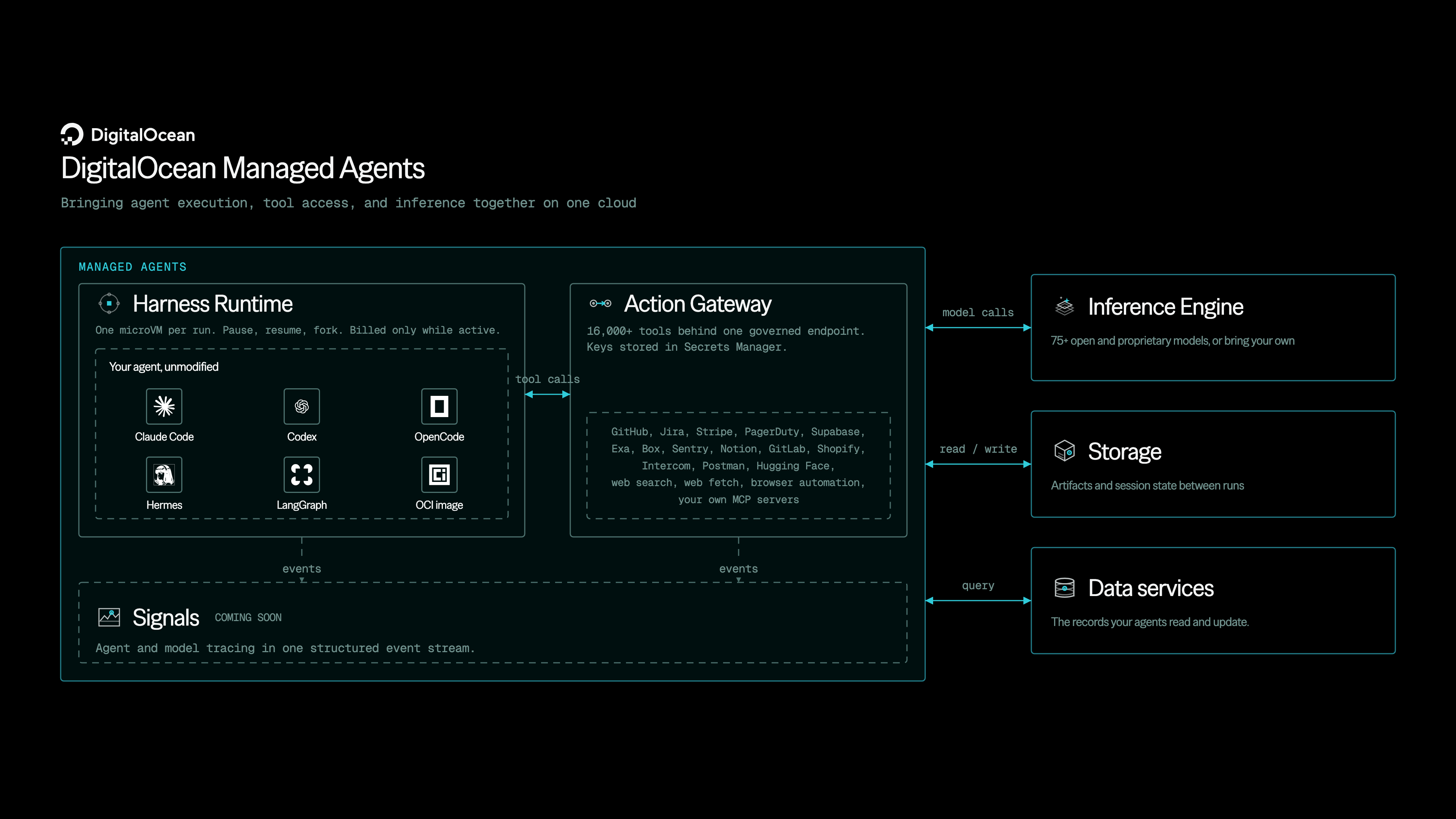
For a walk-through of each component and the DigitalOcean services around them, see Managed Agents Architecture.
Run AI coding agents in isolated DigitalOcean sandboxes with session lifecycle, permissions, and a YAML environment spec.
Give agents access to tools, APIs, and connectors through a managed MCP endpoint or SDK without putting credentials in the model context.
DigitalOcean Harness Runtime now supports OpenHands agents. Run the OpenHands Agent Server in an isolated sandbox, create agents from OpenHands Agent Canvas or the DigitalOcean API, and connect a model such as one from DigitalOcean Serverless Inference. To set up an agent, see How to Run an OpenHands Agent on DigitalOcean Harness Runtime.
DigitalOcean Signals is now available in public preview for Harness Runtime agents and Serverless Inference. Signals detects behavioral signals in conversations, such as a user asking for a human, a failed tool call, or an execution loop, so you can find the conversations that went wrong without reading every transcript. Signals collects data only after you opt in. See Use Signals with Harness Runtime and Use Signals with Serverless Inference.
DigitalOcean Harness Runtime now supports CrewAI agents. Package a CrewAI repository, declare kickoff inputs, connect a model and Action Gateway tools, and deploy your crew in an isolated sandbox. For more information, see How to Run a CrewAI Agent on DigitalOcean Harness Runtime.
Harness Runtime Bring-Your-Own-Template (BYOT) registration now requires a recommended base template (codex-base, opencode-base, claude-code-base, hermes-base, or langgraph-base). Recommended bases provide stronger isolation for custom templates than previously supported bases (coding-codex, coding-opencode, coding-claude-code, coding-hermes, and langgraph). The legacy bases remain available for existing custom templates and for rebuilds of those templates. Support for them in BYOT will be removed in a future release. Sessions that use the legacy base templates as adapter default templates continue to work as usual. For more information, see How to Use a Custom Sandbox Template (BYOT).
For more information, see the full release notes.
Try using different keywords or simplifying your search terms.